
The Biblical Critique of Agrippa's Trilemma
One of the most influential shows on the internet is the Whatever podcast. This podcast, which began as as a prank channel on YouTube pivoted and began to discuss and debate social and polictical issues among Generation Z and millennials. The format takes on two formats: The first format is a panel where the host (Brian Atlas) invites guests and women from all different backgrounds and vocations (most of whom operate in social medial) to discuss relationship, political, even religious issues. The second is a debate format where the host organizes a debate between two or more people of opposing viewpoints concerning a particular political, philsosphical, or religious issue.
One such debater who has appeared multiple times on the Whatever podcast is a young woman by the name of Kayla Turner who goes by her social media handle NotSoErudite. She is a Canadian commentator who focuses on social issues and current events, usually taking a more academic and philosophical approach to her perspectives. She is mostly active on TikTok, X (Twitter), Twitch, and YouTube, where she has amassed over 90,000 subscribers. She is also an active debater and has been a guest on several shows, including Jubilee and Timcast IRL.
One of NotSoEurodite's philosophical arguments against her opponents is what is known as Agrippa's Trilemma. This philosophy was developed by a philosopher named Agrippa who was a avid promoter of Pyrrhonism-a philosophical school of thought created in the first century. This philosophy is found under the umbrella of epistemology (i.e., the study of knowledge or "how do we know what we know?"). It promotes skepticism, which opposes dogma and aims to highlight weaknesses in arguments that claim certainty and rely on reason to determine the truth or falsehood of a particular presuppositional statement. The ultimate purpose of the philosophy of Pyrrhonism is what is known as ataraxia, which is the effect of when a soul is in a tranquil state when one suspends their judgment and results in a mental rest that comes from a person neither denying or affirming anything. Pyrrhonist would argue that non-evident matters (i.e., dogma) prevents a person from experiencing eudaimonia (or a "good spirit").
Agrippa asserted that for any belief that a person holds, the person has no justification to believe that thier belief can be justified, and the person who attempts to do so may fall into one or more of the five categories: 1) Dissent, 2) Infinite progrssion, 3) Perceptual change, 4) Assumption, and 5) Circular reasoning. The first and third mode were addressed by earlier Grecian philosophers, however the second, fourth, and fifth modes advanced the philosophical perspective of Pyrrhonism and led to the creation of Agrippa's Trilemma.
What do each of the modes of Agrippa's Trilemma instruct? Infinite regression of Agrippa's Trilemma instructs that reasoning of one's justification of their belief goes on infinitely (or forever). In order to justify statement A, you have to depend on statement B, and in order to justify statement B, a person needs statement C. In other words, a person can never reach a point of certainty with their knowledge, because according to Agrippa's Trilemma the justification of the statement never stands on its own. Assumption (or Dogmatic Assertion) is the instruction that a person's justification is just assumed to be true, because it is self-evident without offering any proof for one's justification (i.e., I do not have to offer any proof because 'it just is'). The justification of a person's belief is due to a person's arbitrary conviction (or dogma). Circular reasoning, according to Agrippa's Trilemma, is when the justification of a statement of belief relies on the premise of the same statement (e.g., statement A is true because of statement B, and statement B is true because of statement A). A pictorial image of Agrippa's Trilemma is seen below.
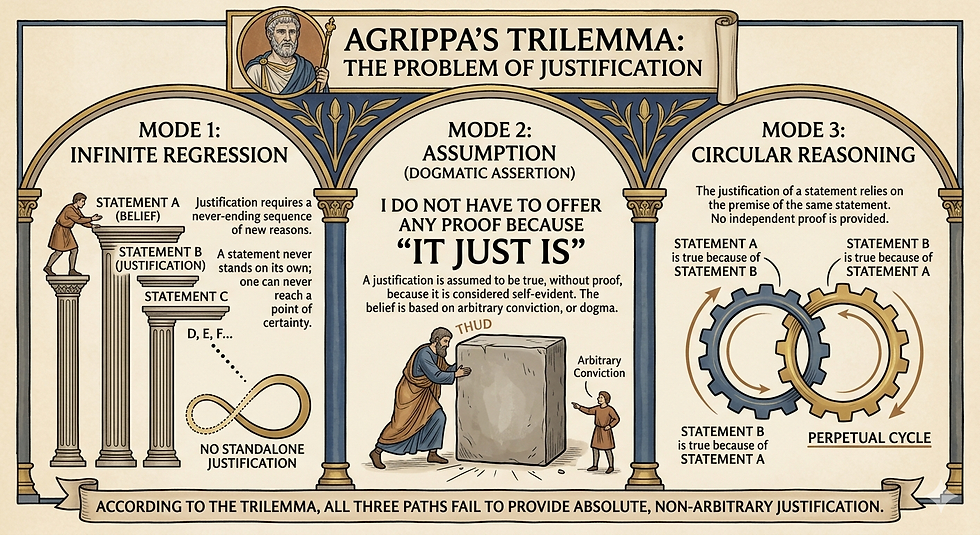
Image created by Google Gemini
From the perspective of Agrippa's Trilemma a person cannot have absolute certainty of what they believe because every person who attempts to justify what they know to be true falls into one (or more) of these categories. This may be true when it comes to belief statements that come from human wisdom. However Agrippa's Trilemma fails under the scrutiny of the biblical philosophy. This is due to the fact that the biblical worldview is not sourced from the mind of men, but the origin of God's word is God Himself (i.e., 2 Timothy 3:16, 2 Peter 1:18-20). So when a person appeals to Scripture, a person is appealing to the mind of God, because it is God Himself who has operated through human authors to write His mind on paper. This is especially important because God's has attributes that humankind does not (and cannot) possess. These qualities are: omniscience (c.f., Isaiah 40:13-14, Romans 11:33-34), onmipresence (c.f., Psalm 7-10), omnisapience (c.f., Job 12:13), eternal (c.f., Deterornomy 33:27, Romans 16:25-26), and transcedence (c.f., Job 26:7, Isaiah 40:22, John 1:1-3). The Scriptures are inspired by God with all of these qualities. These attributes effectively counter the argument of Agrippa's Trilemma.
For instance, with infinite regression, if a Christian asserts that the God of Scripture created the heavens and the earth there are two justifications for this belief. One justification is that God has provided the necessary justification for His existence in creation with the following statement
For the wrath of God is revealed from heaven against all ungodliness and unrighteousness of men who suppress the truth in unrighteousness, because that which is known about God is evident within [or among] them; for God made it evident to them. For since the creation of the world His invisible attributes, His eternal power and divine nature, have been clearly seen, being understood through what has been made, so that they are without excuse (Romans 1:18-20 NASB95, emphasis mine)
Additionally as previously mentioned God has also provided His own justification for His existence by providing the word of God. These two statements fulfill the first problem of infinite regression provided by Agrippa. Scripture also addresses the problem of Dogmatic Assertion. One such reasoning that Scripture provides is the word dogma occurs in Scripture. Originally, it is a word that appears five times in the Greek Scriptures and although it is identified with human ordinances and customs that are sanctioned by governing authorities (c.f., Luke 2:1), and are against the word of Christ (c.f., Ephesians 2:14, Colossians 2:14), it is also identified with message of the apostles
Paul came also to Derbe and to Lystra. And a disciple was there, named Timothy, the son of a Jewish woman who was a believer, but his father was a Greek, and he was well spoken of by the brethren who were in Lystra and Iconium. Paul wanted this man to go with him; and he took him and circumcised him because of the Jews who were in those parts, for they all knew that his father was a Greek. Now while they were passing through the cities, they were delivering the decrees which had been decided upon by the apostles and elders who were in Jerusalem, for them to observe. So the churches were being strengthened in the faith, and were increasing in number daily. (Acts 16:1-5 NASB95, emphasis mine).
Luke wrote that due to the dogma (or decrees) that Paul and Timothy were teaching and the believers were observing resulted in the churches being strengthened. The very point of these doctrines was so that the assemblies who lived in these cities would be certain of the apostles So, if a person believes that the God of Scripture exists according to Scripture this is a self-evident statement where the proof for this statement that is offered is are the two things that are described in the previous point (natural and divine revelation). In other words, the philosophical claims of Scripture are not true just because they are, but they are true because God is the source of truth and He has revealed these claims through His word and reinforced them by creation, which highlights His attributes and thus His existence.
The addressing of the third problem of Agrippa's Trilemma, circular reasoning, once more appeals to Scripture and the knowledge of God observed in physical creation. Once more, if a person asserts the existence of the God of the Scriptures, the proof that God provides within creation and through multiple human authors over thousands of years by divine revelation gives a consistent and linear justification for this claim, as well as all of the other claims God makes by way of the Scriptures.

Image created by Google Gemini
Agrippa's Trilemma, when met with human wisdom is a formidible foe, because human beings do not possess the divine attributes that God possesses. However when human beings appeal to the word of God they appeal to God's mind. So the claims that are made from Scripture are stated from the mind of God, who possesses these unique attributes. Therefore, when a human being appeals to the Scriptures they are appealing to thoughts and concepts that are greater than their own mind, and are able to withstand Agrippa's Trilemma. When it comes to complex philosophical positions the believer in Christ need not be apprehensive of them, nor exchange biblical wisdom and appeal to another human source to refute them. They ought to be assured that the word of God can answer any concept of human wisdom because God through creation and His word has provided the necessary information for believers to do so. This writer ends this article with an appropriate quote from the apostle Paul, explaining God's wisdom by the gospel compared to human wisdom when he wrote the following
For the word of the cross is foolishness to those who are perishing, but to us who are being saved it is the power of God. For it is written, “I WILL DESTROY THE WISDOM OF THE WISE, AND THE CLEVERNESS OF THE CLEVER I WILL SET ASIDE.” Where is the wise man? Where is the scribe? Where is the debater of this age? Has not God made foolish the wisdom of the world? For since in the wisdom of God the world through its wisdom did not come to know God, God was well-pleased through the foolishness of the message preached to save those who believe. For indeed Jews ask for signs and Greeks search for wisdom; but we preach Christ crucified, to Jews a stumbling block and to Gentiles foolishness, but to those who are the called, both Jews and Greeks, Christ the power of God and the wisdom of God. Because the foolishness of God is wiser than men, and the weakness of God is stronger than men.
Until next time...
Soli Deo Gloria!
Dr. LS


Comments